

 https://doi.org/10.32067/GIE.2026.576
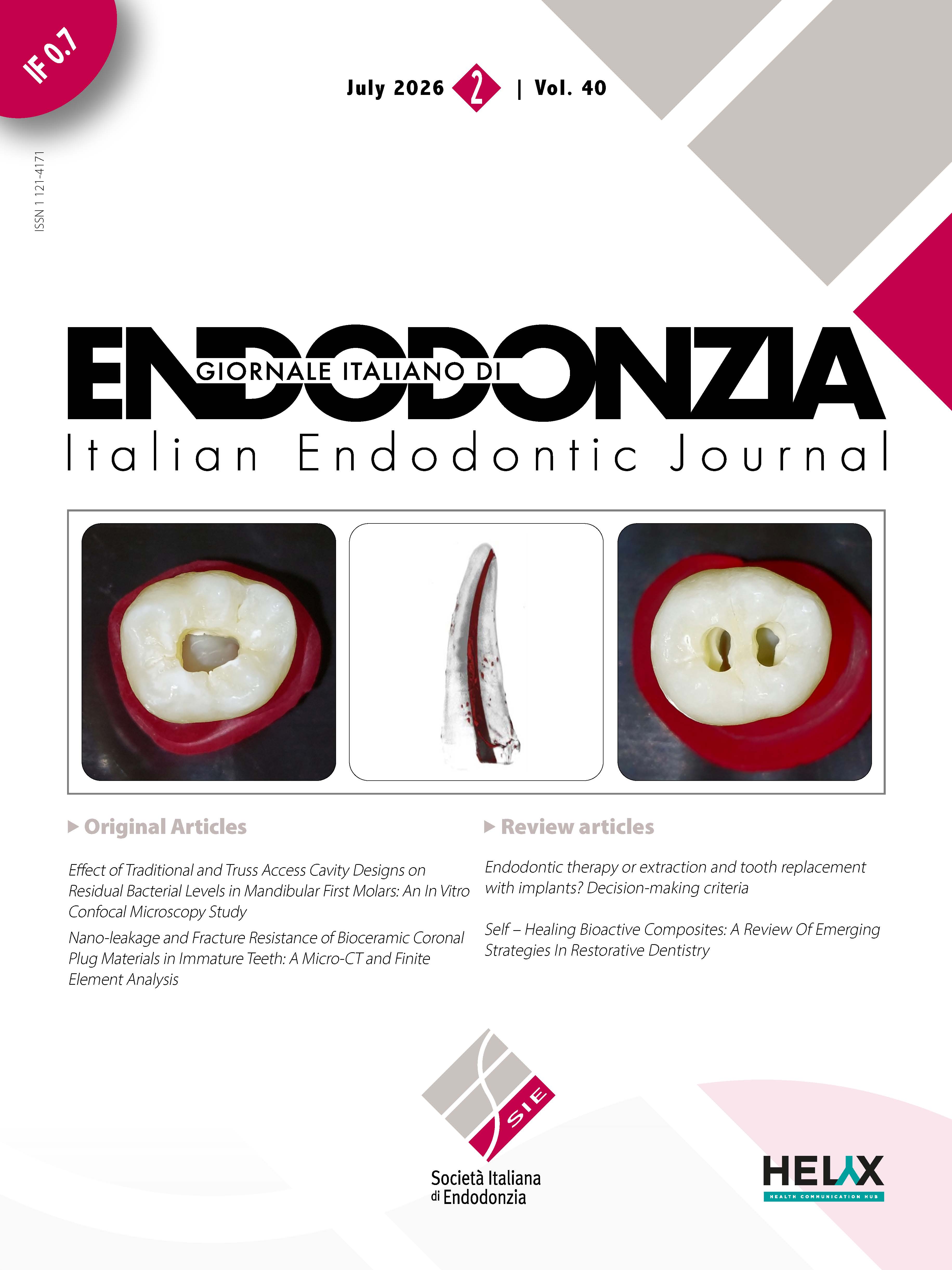
Nano-leakage and Fracture Resistance of Bioceramic Coronal Plug Materials in Immature Teeth: A Micro-CT and Finite Element Analysis
All claims expressed in this article are solely those of the authors and do not necessarily represent those of their affiliated organizations, or those of the publisher, the editors and the reviewers. Any product that may be evaluated in this article or claim that may be made by its manufacturer is not guaranteed or endorsed by the publisher.
Accepted: 23 May 2026
Published: 28 July 2026
Aim To evaluate the effect of MTA Repair HP, Biodentine, and Bio-C Repair coronal plugs on nano-leakage and fracture resistance in simulated immature teeth using Micro-computed tomography (Micro-CT) and finite element analysis (FEA).
Methodology Sixty-four extracted human maxillary central incisors were standardized and prepared to simulate immature teeth with blunderbuss canals. The specimens were randomly allocated into four groups (n = 16) according to the coronal plug material used: Group 1, Bio-C Repair; Group 2, Biodentine; Group 3, MTA Repair HP; and Group 4, control group with collagen foam. Following placement of the materials, nano-leakage evaluation was performed using silver nitrate infiltration and Micro-CT analysis. Leakage values were calculated volumetrically and expressed as percentages. Finite element analysis was performed using three-dimensional models generated from cone beam computed tomography data to evaluate stress distribution, maximum principal stress, failure index, and tooth weakening percentage under simulated functional loading conditions. Statistical analysis for nano-leakage was performed using the Kruskal–Walli’s test followed by Dunn’s post hoc analysis with significance set at p < 0.001.
Results Bio-C Repair demonstrated the lowest nano-leakage values among all experimental groups, whereas the control group exhibited the highest leakage values. Statistically significant differences were observed between Bio-C Repair and MTA Repair HP, Bio-C Repair and the control group, and Biodentine and the control group (p < 0.001). Finite element analysis demonstrated that the untreated immature tooth model exhibited the highest stress concentration and failure index. Among the tested materials, MTA Repair HP and Bio-C Repair demonstrated lower stress concentration and more favourable biomechanical behaviour compared with Biodentine. Stress concentration was predominantly localized in the cervical region of the root.
Conclusion Bio-C Repair demonstrated superior sealing ability with the least nano-leakage among the tested materials. MTA Repair HP and Bio-C Repair exhibited more favourable stress distribution and reduced fracture susceptibility compared with Biodentine in simulated immature teeth.
Downloads
Supporting Agencies
How to Cite

This work is licensed under a Creative Commons Attribution-NonCommercial 4.0 International License.
Giornale Italiano di Endodonzia has chosen to apply the Creative Commons Attribution NonCommercial 4.0 International License (CC BY-NC 4.0) to all manuscripts to be published.